
Node.js: How JavaScript Conquered the Server
For years, JavaScript was confined to a single environment: the web browser. It was the language we used to manipulate webpage elements and handle client-side logic. Today, however, JavaScript powers high-performance backend infrastructures, APIs, and real-time data streams.
To understand how a browser scripting language became a backend powerhouse, we need to look at Node.js.
JavaScript: Language vs. Runtime
Before diving into Node.js, it is crucial to separate the programming language from the runtime.
The Language: JavaScript defines the syntax, rules, and logic we write in our code editor.
The Runtime: The runtime is the actual software environment that parses, compiles, and executes our JavaScript code.
Why JavaScript Was Originally Browser-Only
In the early days of the web, runtimes only existed inside web browsers (like Chrome, Firefox, or Safari).
In a browser runtime, JavaScript is strictly isolated. It has access to the Document Object Model (DOM) to update the user interface, but it is intentionally blocked from accessing the computer's operating system. For security reasons, browser-based JavaScript cannot read local files, open network ports, or connect directly to a database.
To handle those system-level tasks, we traditionally relied on backend languages and runtimes like PHP, Java, or Python.
The Shift: How Node.js Made JavaScript Run on Servers
In 2009, developer Ryan Dahl sought to bring JavaScript to the backend. He took the V8 Engine—the highly optimized, open-source JavaScript engine developed by Google for the Chrome browser—and extracted it from the browser environment.
He embedded the V8 engine within a C++ program and added new libraries that allowed JavaScript to interact directly with the operating system. He called this new runtime Node.js.
With Node.js, our JavaScript code could suddenly read files, query databases, and listen for HTTP requests.
Browser Executon vs Node.js Execution
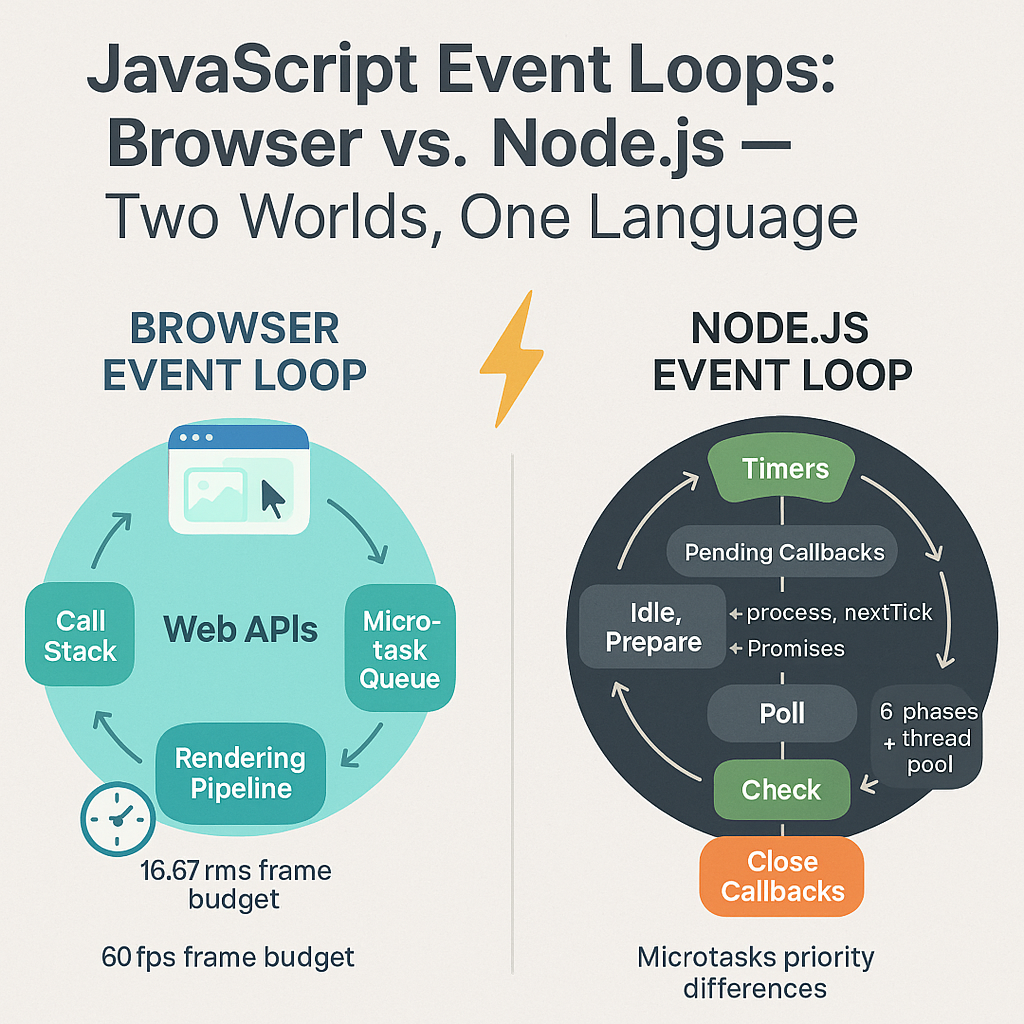
The Core Advantage: Event-Driven Architecture
Developers did not just adopt Node.js to unify their language stack; they adopted it for its highly efficient architecture.
Traditional backend runtimes, like PHP or Java, typically use a multi-threaded, blocking model. When a user sends a request, the server allocates a dedicated thread. If the code needs to query a database, that thread halts and waits for the response. This blocks the thread, consuming system memory while doing no actual work.
Node.js uses a single-threaded, non-blocking, event-driven model.
When our Node.js server makes a database query, it does not stop and wait. It registers a callback function and immediately moves on to handle the next incoming request. Once the database finishes its task, it pushes an event to the Event Queue. The Node.js Event Loop picks up that event and executes our callback.
Node.js in Action
Because of this non-blocking architecture, Node.js is incredibly lightweight. We can spin up a web server that handles concurrent requests with just a few lines of code.
Here is a clean example of a basic Node.js server returning JSON data:
const http = require('http');

const server = http.createServer((req, res) => {
    res.writeHead(200, { 'Content-Type': 'application/json' });

    res.end(JSON.stringify({
        status: 'success',
        message: 'Hello from our Node.js backend!'
    }));
});

server.listen(3000, () => {
    console.log('Server is running and listening on http://localhost:3000');
});
Real-World Use Cases
This architecture makes Node.js highly specialized for specific types of applications:
Full-Stack Development: It enables the MERN stack (MongoDB, Express, React, Node.js), allowing our teams to write the entire application—frontend and backend—in JavaScript.
Real-Time Applications: Because it handles thousands of concurrent connections efficiently without exhausting memory, it is the standard for chat applications, live dashboards, and collaborative tools.
Data Streaming: Node.js processes data in continuous streams rather than waiting for entire payloads to load, making it ideal for video platforms and massive file processing.
Microservices: Its minimal overhead makes it perfect for building fast, independent API services that communicate with each other in a larger system.
Summary
Node.js fundamentally changed backend development. By extracting JavaScript from the browser and pairing it with a non-blocking, event-driven architecture, it provided us with a lightweight, highly scalable environment capable of handling the demands of modern web applications.